-
SENSORY INTEGRATION, REHABILITATION
- Occupational therapy (Ergo therapy)
- Balance
- Vestibular
- Physiotherapy
- Logotherapy
- Kinesiotherapy
- Aromatherapy
- Music therapy
- Writing Develops
- Weighted products
- Fine motor
- Sand theraphy
- Tactile
- Sensory integration
- Tracking & Threading
- For children up to 2-years-old
- Activities for adults
- Autism
- Dementia
- Relaxation
- CLEARANCE
-
SENSORY PRODUCTS
- Sensory rooms
- Interactive projections
- Wireless control panels, systems
- Wall panels
- Bubble tubes and bubble walls
- Luminous fibers, carpets
- Special lighting
- Bean bags
- Puzzles, mosaics, constructors
- Projectors
- Soft furniture
- CDs, DVDs, training
- Hammocks, swings
- Educational games
- Padded, soft toys
- Soft pools with balls
- UV sensory devices
- Balls
- Mirrors
- Sound systems and accessories
- Aroma diffusers and their accessories
- Blankets, vests, collars
- Headphones, helmets
-
NURSING PRODUCTS
- Electric nursing beds
- Cabinets and tables
- Hospital functional beds
- Fall prevention
- Bedsore prevention products
- Comfort chairs
- Lifts, hoists
- Belts for lifts, hoist
- Patient lifting and handling equipment
- Fixations and restraints
- Shower, toilet and bath equipment
- Blinds
- Logistic trolleys
- Protective bedding, mats
- Bariatric products (for overweight users)
- Equipment for disabled
-
NURSING EQUIPMENT SELECTION GUIDE
- For patients with Alzheimer's and dementia
- Nursing at home
- For tetraplegics
- For the prevention and treatment of bedsores
- For patients with urinary incontinence
- For children with disabilities
- Walking aids
- Disability
- Adaptation of housing for the disabled
- For care homes
- For medical institutions
- Mental health centers
- For heavy-weight patients
- Free number - +37041540204
- Contact us - info@slaugivita.com
Projects
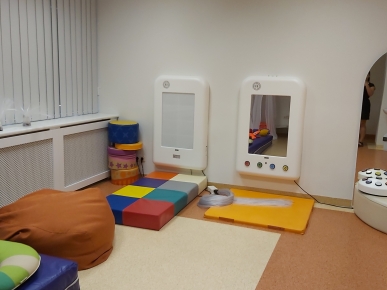
Klaipeda Home for Children with Developmental Disabilities
2020-07-29
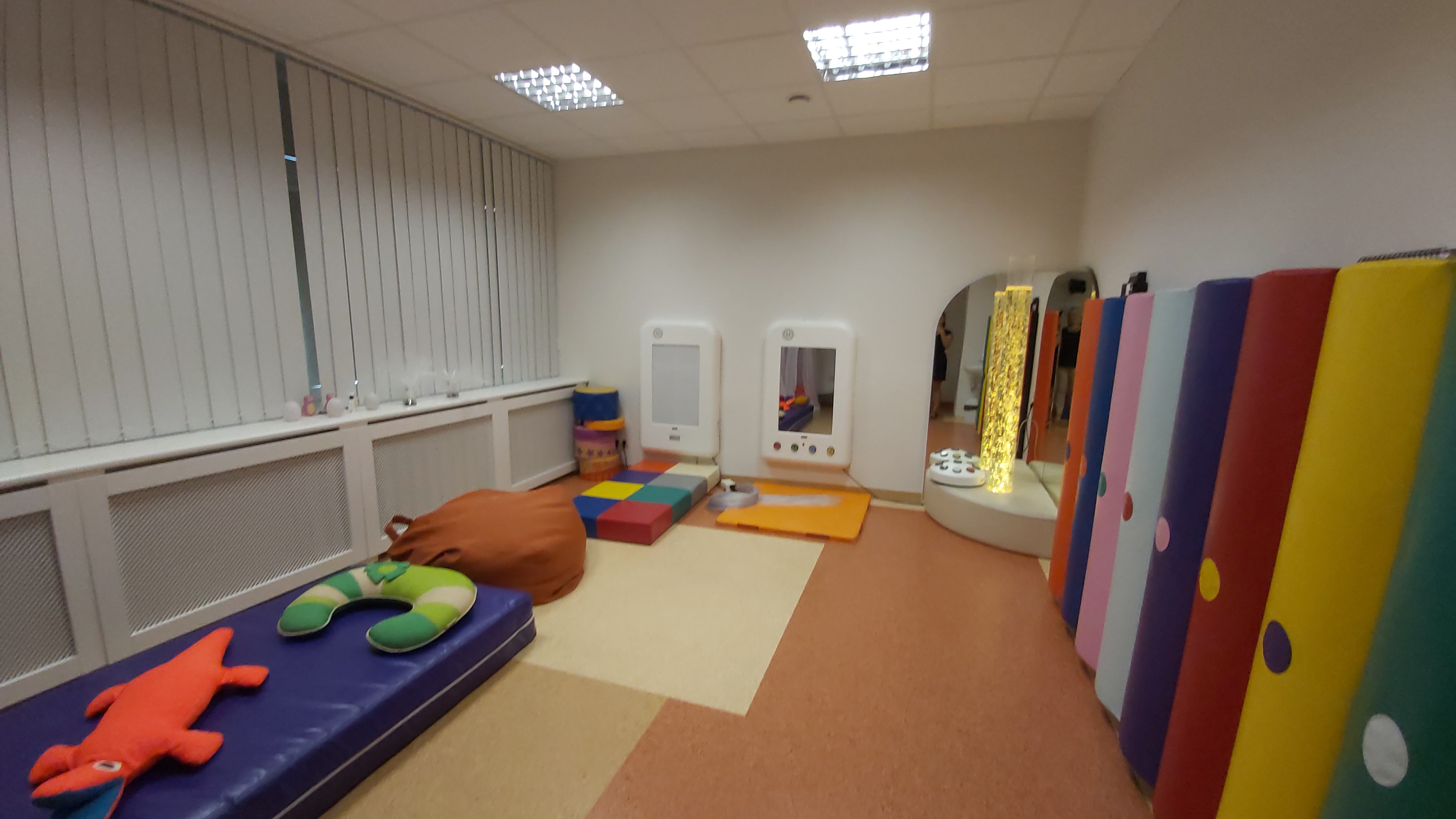
Communicating with others for people with autism spectrum disorder can be a challenge, and being exposed to the sensory environment around them can become unbearable. This can exacerbate stereotypical and behavioral problems. By changing the sensory needs and focusing on the abilities of the individual, the amount of these abnormal behavior problems can be reduced. Such a change can also help with the processing of sensations and information, so there will be fewer problems in adulthood. If a child has difficulty interpreting a sensory experience, one can understand why he sees a world differently from us. One of the tools that can help process the senses is the "Snoezelen" environment. Snoezelen provides a spectrum of sensory stimulation that can be tailored to the needs of the autistic person to manage sensory processing and help prepare for engaging in meaningful activities.
The behavior of individuals with autism spectrum disorders involves three main components: impaired social interaction, impaired communication, and impaired sensory processing.
* Behaviour during social interactions includes limited eye contact, facial expressions, and social gestures. "Snoezelen" does not rely on direct social interactions and is therefore acceptable regardless of the level of social skills. Activities can be adjusted by individual needs to facilitate autonomous, parallel, and collaborative interactions.
* When communication is impaired, children with autism often learn to understand and speak later than normal. "Snoezelen" can be used with transitions (modifications) to enhance communication and learning using a sensory approach.
* Disorder of sensory processing can result in a feeling of overcrowding in our sensory environment, which can lead to feelings such as frustration, which then might lead to mood swings and loss of control. In the "Snoezelen" room, the level of stimulation can be increased or decreased to control levels of sensory arousal or to change behavior.
"Snoezelen“ environment
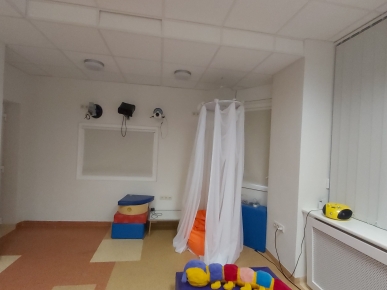
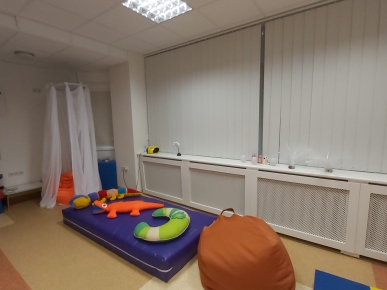
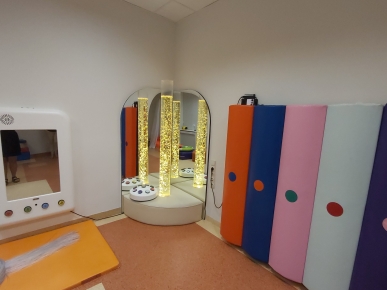
The Snoezelen environment provides direct or indirect stimulation of sensory modalities and can be used individually or as a whole to apply a sensory approach. Equipment that may be suitable for people with autism includes:
- Visual Stimulation (Visual) - Illuminated beams, projector with images of memories, bubble tubes.
- Audio Stimulation (Sound) - Relaxing audio recordings, equipment vibration noise, wind chimes, music to suit patients' musical tastes.
- Smells - Aromatherapy, familiar perfumes and aftershave lotions. For example, perfume or aftershave lotions used by parents can reduce anxiety levels.
- Tasting - Any nutrient that gives different flavors or ingredients. People with autism can focus on specific tastes or substances. The challenge may be to gently increase this range.
- Tactile Stimulation (Touch) - Vibrating pillows and mattresses, weighted blankets made of different textured fabrics.
- Proprioreceptor and vestibular stimulation (Movement) - Rocking chairs, rocking horses. Stretching and reaching equipment.
The Snoezelen environment should be considered as a “kit” with different types of sensory equipment that meet the different sensory needs of the person using it. Not all Snoezelen environment devices should be turned on at the same time.
Evaluation
An assessment should be made before using Snoezelen for children with autism spectrum disorders.
Assessment tools can be:
• The Sensory Assessment and Profiling Tool (Collier, 2003) - This assessment determines a person's sensory priorities. It is recommended that Snoezelen sessions be initiated using equipment tailored to the individual's sensory priorities. This will help move to the Snoezelen room and can be used as a starting point for stimulating other sensations with good therapy results.
• The Sensory Profile (Dunn, 1999) - This assessment determines the level of stimulation a person needs. The assessment identifies individuals with different sensory boundaries and orientations to different sensory modalities. With this information, the required level of stimulation can be adjusted using Snoezelen.
• The PAL Activity Level Tool (PAL) Instrument for Occupational Profiling, Pool, 2011 - This assessment is best suited for adults with autism, it indicates how to adapt Snoezelen sessions according to the severity of the disorder identified. It explains how to systematize activities, facilitate Snoezelen sessions, describes the characteristics of the activity, and how to start and end a session.
• Multisensory environments information sheets (Pagliano, 2001) - These factsheets help to monitor progress in the Snoezelen environment by recording behavioral responses in a standardized way. The focus is on personal skills and the environmental aspects of Snoezelen, which help and support development and learning.
Recommendations for using the Snoezelen Room
Follow these guidelines, along with clearly stated assessment tools. Guidance on how to use Snoezelen can be found in the PAL Professional Profiling Tool (Pool, 2011).
Bibliography
Baird, G et al (2006) Prevalence of disorders of the autism spectrum in a population cohort of children in South West Thames: the Special Needs and Autism Project (SNAP). The Lancet, 368(9531), p. 210-215.
Collier, L (2003) The Sensory Preference and Profiling Tool. Rompa. UK
Dunn, W (1999) The Sensory Profile. Pearsons, UK
Pagliano, P (2001) Using a Multisensory Environment. David Fulton Publishers. UK
Pool, J (2011) The Pool Activity Level (PAL) Instrument for Occupational Profiling. Jessica Kingsley.
|
Slaugivita - solutions that pay off! |
Contact us
- Dubijos str. 16, LT-77172 Šiauliai, Lithuania
- info@slaugivita.com
-
+370 41 540204
Tel.: +(370) 41 540204

Products
- 1
- 2
- 3
- 4
- 5
- 6
Useful links
Details
Įm. kodas: 145440368
PVM kodas: LT454403610
AB „SWEDBANK“
A/s nr.: LT987300010089460228
PVM kodas: LT454403610
AB „SWEDBANK“
A/s nr.: LT987300010089460228